If you search for Jev AI latency, you will see four completely different numbers quoted side by side: 114 ms, 212 ms, 310 ms, and 0.4 s—plus TypeSafe's headline "193.6× faster" multiplier. Without knowing how each number was measured, engineering teams either over-promise 100 ms SLAs to product managers or dismiss the speedup as marketing hype.
This guide separates every verified Jev AI latency measurement by source, payload size, and network path so you can budget real p50 and tail latency in production. All timings below come directly from TypeSafe AI's published evals and launch demo, OpenRouter's live telemetry, independent GitHub benchmarks, Vercel's TechCrunch quote, and our own six production-shaped requests on jev-ai.org.
Every Verified Jev AI Latency Number, Side by Side
| Measurement Source | Jev AI Latency | Cost / Context | Important Caveat |
|---|---|---|---|
| TypeSafe homepage demo | 114 ms (0.114 s) | $0.000081 vs. LLM 8.566 s ($0.013880) | Single short, dense query that TypeSafe notes flatters Jev |
Independent Doom loop (jev-plays-doom) | 212 ms avg | Across 2,642 live calls | Short game-state inputs; single scenario |
| OpenRouter model page (P50) | 220 ms (0.22 s) | 7-day rolling P50 on typesafe/jev-1.13 | Server-side / OpenRouter gateway median |
Our 6 production-shaped calls (jev-ai.org) | ~310 ms median | $0.000023–$0.000038 per call | Full round trip via OpenRouter from our backend |
| TypeSafe 4-workflow eval | 400 ms (0.4 s) | $0.0004/case (67.8% agreement) | Multi-step workflows vs. best LLM at 23.3 s ($0.0836, 74.1%) |
| Vercel live safety classifier (TechCrunch) | 5–18× faster than LLM | Production safety workload | Customer quote; raw ms dataset not published |
Why Jev AI Latency Stays Sub-Second Even With Multiple Questions
A standard chat LLM generates output sequentially—one token per forward pass. Asking an LLM to output a 120-token JSON object with reasoning fields takes 120 sequential decode steps, easily pushing latency to 2–23 seconds.
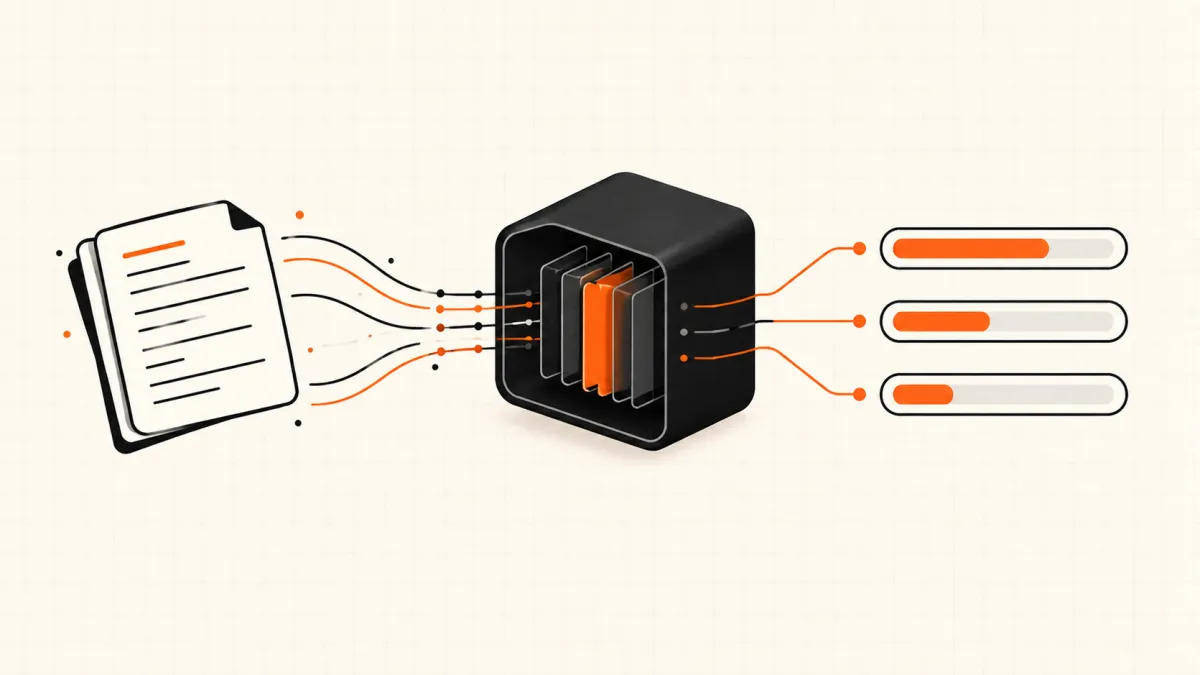
Jev AI latency avoids that autoregressive loop completely:
- No free-form token generation. Jev processes your
stateand scores your declarednoul,choice, andscorequestions in a single parallel pass—returning probabilities instead of sentences. - Flat scaling across questions. Because questions run in parallel over the same input
state, adding a fourth or fifth policy check barely changes Jev AI latency compared with sending one question. - Zero streaming complexity. You do not need SSE chunk parsers or partial-JSON repair libraries; the entire typed response arrives in ~220–400 ms.
What Actually Moves Jev AI Latency in Your App
When teams see Jev AI latency drift from ~220 ms toward 500+ ms, three factors explain almost every millisecond:
- Network geography and gateway hops. TypeSafe's 0.4 s workflow eval was measured from US West Coast laptops close to TypeSafe's infrastructure. Calling via OpenRouter from Europe or Asia adds standard TLS and routing round-trip time—which is why our live Jev AI latency measured ~310 ms while OpenRouter's internal P50 read 220 ms.
- Input
statelength. Jev accepts up to 32K input tokens. Sending a clean 400-token ticket or chunk keeps Jev AI latency near the 200–310 ms range; dumping 20,000 tokens of raw HTML logs increases prefill time noticeably. - Sequential chaining instead of parallel questions. Making three separate HTTP calls for moderation, routing, and urgency triples your network overhead. Combine independent decisions over the same text into one Jev AI latency-optimized call.
How to Benchmark Jev AI Latency for Your Own SLA
Do not copy a blog's median into a production SLA. Measure your own Jev AI latency in ten minutes:
- Prototype your exact schema on the Jev AI Model Playground to preview Jev AI latency interactively.
- Send 50 representative production payloads from your actual deployment region (pinned to
typesafe/jev-1.14) to capture real Jev AI latency variance. - Record p50, p95, and timeout behavior—and compare Jev AI latency against your current LLM classifier using our Jev AI pricing breakdown and OpenRouter Jev setup.
For full accuracy vs. Jev AI latency trade-offs across all four TypeSafe workflows, read TypeSafe AI Jev Benchmarks.
Frequently Asked Questions
Why is Jev AI latency 114 ms in the demo but ~310 ms in live apps?
TypeSafe's 114 ms demo used one short, dense query close to its servers. Real production apps include network round-trip time, gateway overhead, and longer text payloads—putting typical live Jev AI latency around 220–400 ms.
Does adding more questions increase Jev AI latency linearly?
No. Jev evaluates noul, choice, and score questions in parallel against the same state, so combining 3–6 questions into one call keeps Jev AI latency nearly flat compared with separate sequential requests.
How much faster is Jev AI latency than a frontier LLM?
In TypeSafe's four-workflow eval, Jev AI latency averaged 0.4 s vs. 23.3 s for the top LLM (~58× faster) and 10.1 s for an equal-accuracy LLM (~25× faster). In production, a Vercel engineer reported 5–18× faster execution via TechCrunch.
Where can I test Jev AI latency myself right now?
Run live queries in the Jev AI Model Playground to see real response times on your own text before integrating the API.
Sources
- TypeSafe AI Workflow Evals — Published 0.4 s vs. 23.3 s workflow latency and cost comparisons.
- TechCrunch — Vercel Safety Classifier Speedup — Reports 5–18× faster execution on a live safety classifier.
- OpenRouter — typesafe/jev-1.13 — Public P50 latency (0.22 s) and endpoint specifications.
- TypeSafe AI Jev Benchmarks (jev-ai.org) — Our six measured production-shaped calls (~310 ms median, $0.000023–$0.000038/call).