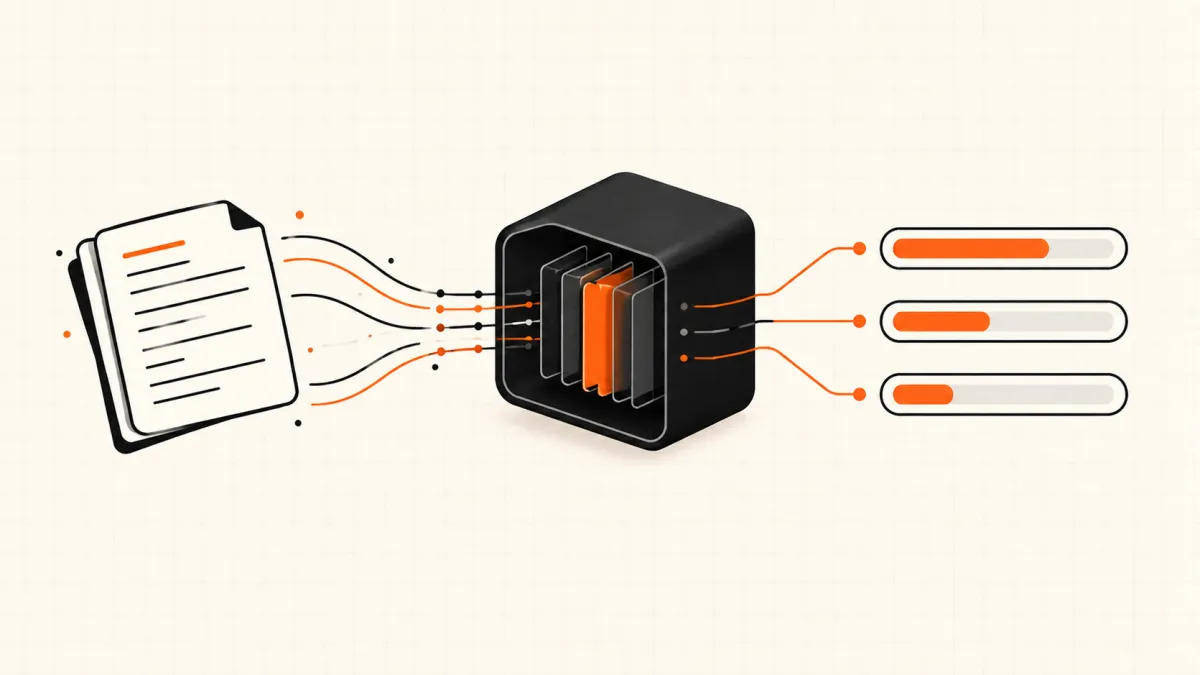
Every customer support queue, API gateway, and multi-agent orchestrator starts with the same bottleneck: deciding where an incoming request should go before expensive compute runs. Prompting a frontier chat LLM to output a JSON route label adds seconds of latency and burns tokens on boilerplate prose. Jev AI routing replaces that chat-prompt pattern with a dedicated System-1 decision model from TypeSafe AI (typesafe/jev-1.13, typesafe/jev-1.14, or ~typesafe/jev-latest) that scores intent, urgency, and destination queues in a single parallel pass.
In this Jev AI routing guide, you will learn how to structure choice, noul, and score questions for intent and ticket triage, route requests with calibrated probability cutoffs instead of brittle argmax labels, and keep per-decision costs near $0.000023–$0.000038 with ~310 ms live median round trips.
Why Jev AI Routing Beats Chat-Prompt Routers
Traditional LLM routers ask a generative model to read a message, reason in text, and emit a route key. Even when constrained with JSON mode, you still pay for output tokens and wait on autoregressive decoding. Jev AI routing removes free-form generation entirely: you send one state (up to 32K input tokens) to OpenRouter's Decisions API (POST https://openrouter.ai/api/alpha/decisions) or System One API (POST https://openrouter.ai/api/v1/systemone), and Jev evaluates every routing question in parallel at $0.042 per 1M input tokens and $0 output tokens.
| Routing Metric | Jev AI Routing (typesafe/jev-1.14) | Frontier Chat LLM Router |
|---|---|---|
| Measured live round trip | ~310 ms median (our 6 live calls) | 2–23 s depending on reasoning depth |
| TypeSafe workflow eval | 0.4 s · $0.0004/case (67.8% agreement) | 23 s · $0.084/case (74.1% agreement) |
| Token billing | $0.042 / 1M input · $0 output | Input + output tokens per route |
| Output contract | Calibrated probabilities (noul/choice/score) | Free-form text or parsed JSON |
| Multi-label overhead | Parallel scoring in one pass | Longer prompt + more output tokens |
Because Jev AI routing returns calibrated probabilities rather than a bare string, your router can distinguish between a 94% confident billing refund and a 51% ambiguous edge case that should fall back to a human or a stronger LLM.
Designing a Multi-Signal Jev AI Routing Schema
A strong Jev AI routing payload combines three complementary decision primitives over the same state:
choicefor primary intent or queue: Picks among mutually exclusive destinations such asbilling,technical_support,security,sales, orgeneral.noulfor binary escalation flags: Checks independent conditions in parallel—for example, whether the user threatens churn, reports a live outage, or requests PII deletion.scorefor priority or complexity tier: Ranks ticket urgency (low,medium,high) or query difficulty so your Jev AI routing layer can decide between a fast small model and a frontier reasoning model.
Here is a production Jev AI routing request sent to the Decisions API:
curl https://openrouter.ai/api/alpha/decisions \
  -H "Authorization: Bearer $OPENROUTER_API_KEY" \
  -H "Content-Type: application/json" \
  -d '{
    "model": "typesafe/jev-1.14",
    "state": "Customer: Our webhook signing secret stopped verifying after the 02:00 UTC deploy. Production checkout is blocked for 40+ orders.",
    "questions": {
      "queue": {
        "type": "choice",
        "question": "Which team should own this support ticket?",
        "choices": ["billing", "platform_engineering", "account_management", "general_support"]
      },
      "is_production_outage": {
        "type": "noul",
        "question": "Is the customer reporting an active production outage or blocked revenue?"
      },
      "severity": {
        "type": "score",
        "question": "What is the operational severity of this ticket?",
        "tiers": ["p3_normal", "p2_high", "p1_critical"]
      }
    }
  }'
Evaluating all three questions in one Jev AI routing call avoids sequential waterfall hops and keeps total latency under half a second. You can prototype and inspect probability splits on your own ticket transcripts in the Jev AI Model Playground.
Confidence-Gated Jev AI Routing Logic
Never wire Jev AI routing straight to argmax without checking probability margins. A robust Jev AI routing handler applies three bands:
- High confidence (
p >= 0.80): Auto-assign directly to the winning queue or downstream tool without extra LLM calls. - Ambiguous band (
0.45 <= p < 0.80): Route to a secondary frontier LLM classifier or attach a "needs triage" tag for human review. - Outage override (
is_production_outage >= 0.70): Page on-call engineering immediately regardless of the primary queue label.
This hybrid Jev AI routing pattern captures the best of both worlds: 80–90% of routine tickets and chat intents resolve in ~310 ms at fractions of a cent, while only genuinely ambiguous cases escalate to a slower reasoning model. For a deeper comparison of hybrid architectures, see Jev AI vs LLM: When to Use a Decision Model First and Jev AI Classification: Fast Routing & Guardrails.
Jev AI Routing vs typesafe/jev-router
Developers often confuse custom Jev AI routing with typesafe/jev-router on OpenRouter. They solve different jobs:
typesafe/jev-routeris a pre-built chat router that automatically dispatches chat completions across upstream LLMs.- Custom Jev AI routing calls
typesafe/jev-1.13ortypesafe/jev-1.14on/api/alpha/decisionsor/api/v1/systemoneso you control the exact queues, SLA flags, and probability thresholds inside your own application code.
When your business logic depends on domain-specific queues, compliance flags, or custom fallback thresholds, build custom Jev AI routing and pin a specific model snapshot (typesafe/jev-1.14) rather than relying on the rolling ~typesafe/jev-latest alias.
Frequently Asked Questions
How fast is Jev AI routing in production?
In our six production-shaped live calls on jev-ai.org, Jev AI routing achieved a ~310 ms median round trip, while TypeSafe's four-workflow evaluation averaged 0.4 s per case—5–18× faster than prompting a frontier LLM.
How many queues can one Jev AI routing call evaluate?
You can pass a choice list covering your support queues alongside multiple parallel noul and score checks in the same request, sharing up to 32K input tokens of ticket or conversation state.
Should I use typesafe/jev-1.14 or ~typesafe/jev-latest for Jev AI routing?
Pin typesafe/jev-1.14 (or typesafe/jev-1.13) once you tune Jev AI routing probability thresholds so a model update never shifts your escalation rates silently.
Where can I test Jev AI routing schemas before deploying?
Open the Jev AI Model Playground to test live ticket and intent payloads, or read the Jev AI API Quickstart for full endpoint setup.
Sources
- TypeSafe AI Documentation — Introduction — Official
noul,choice, andscoreprimitives for decision routing. - OpenRouter — typesafe/jev-1.13 Model Page — Decisions API endpoint, 32K input context, and $0.042/1M input pricing.
- TypeSafe AI Workflow Evals — Published four-workflow latency and cost comparison (0.4 s / $0.0004 vs. 23 s / $0.084).
- jev-ai.org Model Playground — Live browser testing environment and measured ~310 ms median round-trip calls.