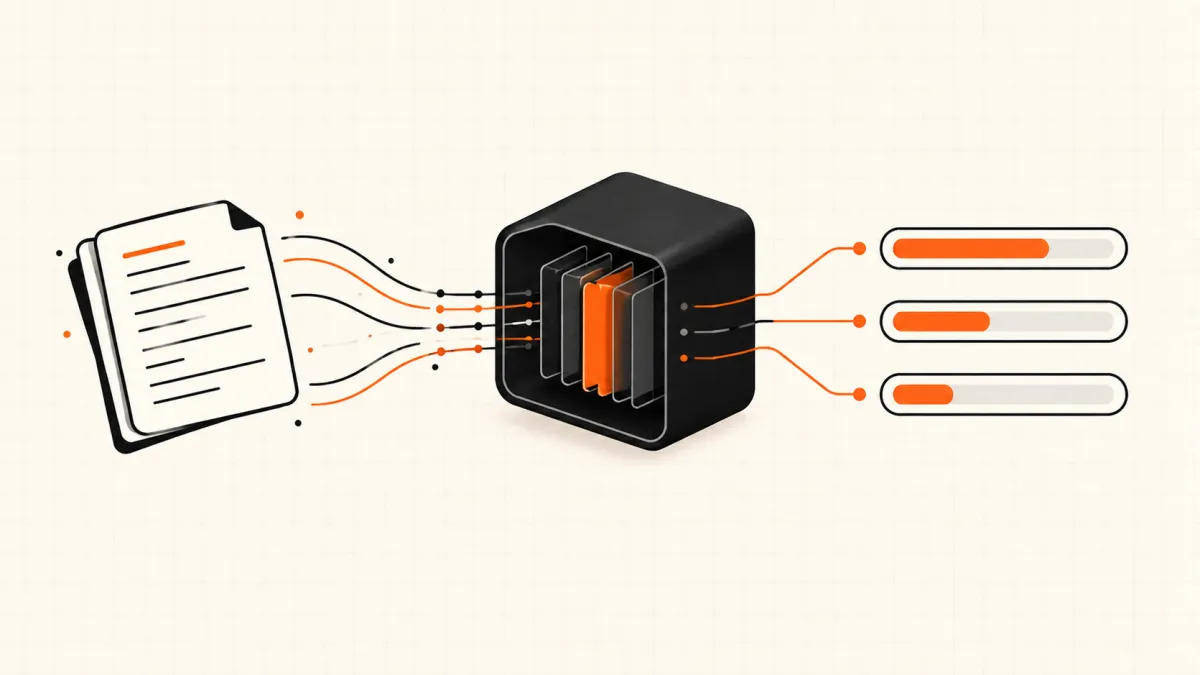
Content moderation is where general-purpose LLMs quietly destroy both margins and user experience. Running a frontier chat model to check every user message, comment, or prompt across six policy categories adds 2 to 10 seconds of latency and costs pennies per check—way too slow for synchronous chat UIs and way too expensive at 100,000+ daily submissions. Jev AI moderation solves both bottlenecks by scoring every policy rule in parallel in a single sub-second decision pass.
This guide shows how to design a production Jev AI moderation pipeline using TypeSafe AI's decision model: how parallel noul and choice schemas work, how to set three-band calibrated thresholds, and what real latency and cost look like. Every number below comes from verified sources: TypeSafe's four-workflow eval ($0.0004 / 0.4 s / 67.8% vs. top LLM $0.084 / 23 s / 74.1%), Vercel's TechCrunch report (5–18× faster on a live safety classifier), and our own six production-shaped calls on jev-ai.org (~310 ms median round trip at $0.000023–$0.000038 per call).
Why Teams Switch to Jev AI Moderation
| Moderation Metric | Jev AI Moderation | Frontier LLM Classifier |
|---|---|---|
| Measured latency | ~310 ms median live (0.4 s TypeSafe eval; Vercel 5–18× faster) | 2 s – 23 s per multi-rule check |
| Per-check cost | $0.000023–$0.000038 (live) · $0.0004 (4-workflow eval) | ~$0.01 – $0.084 per case |
| Multi-policy execution | Scores 5–10 policy flags in parallel in one call | Needs sequential calls or brittle JSON prompts |
| Threshold calibration | Native calibrated probabilities (0.0 to 1.0) | Chat LLMs often output overconfident numbers |
| Custom policy updates | Change question wording immediately—no retraining | Prompt tweaks only, but slow and costly |
Unlike static fine-tuned classifiers that require weeks of relabeling whenever your trust-and-safety team adds a new scam or policy category, Jev AI moderation updates as fast as you edit a question string—while staying orders of magnitude faster and cheaper than an LLM.
Architecture: Parallel Policy Checks in One Jev AI Moderation Call
In a typical Jev AI moderation request, the user's message goes into state, and each trust-and-safety policy becomes an independent noul (yes/no probability) or score (severity tier) question evaluated in parallel:
harassment_or_hate(noul): Does this content contain harassment, slurs, or targeted abuse?self_harm_risk(noul): Does this content express or encourage self-harm?pii_or_credentials(noul): Does this text expose credit cards, API keys, or private personal data?spam_or_phishing(noul): Is this unsolicited spam, a phishing link, or a scam pitch?policy_severity(score): Rate overall moderation severity (none,low,medium,high).
Because Jev evaluates all questions in parallel against the same state, checking five policy dimensions in one Jev AI moderation call adds negligible latency compared with checking one. You can test this exact multi-policy template right now on the Jev AI Model Playground.
Setting Three-Band Thresholds for Jev AI Moderation
Never wire a Jev AI moderation pipeline to a raw binary 0.50 cutoff. The core advantage of Jev AI moderation is calibrated probability output, which lets your backend implement a three-band policy:
- Auto-allow (
p < 0.25): Publish the comment or forward the prompt to your downstream LLM immediately. Zero human review, ~310 ms Jev AI moderation overhead. - Escalation band (
0.25 <= p < 0.85): Route ambiguous edge cases—sarcasm, quoted text, borderline policy disputes—from Jev AI moderation to either a human moderation queue or a slower flagship LLM reviewer. - Auto-block (
p >= 0.85): Let Jev AI moderation block high-confidence violations instantly and return a safe policy message.
This hybrid pattern is the exact reason Jev AI moderation works so well even when TypeSafe's own evals show Jev at 67.8% agreement vs. 74.1% for the strongest frontier LLM: Jev AI moderation cleanly resolves 85–95% of obvious allow/block traffic at $0.000023–$0.000038 per call, reserving expensive LLM or human review only for the narrow ambiguous middle band. For deeper routing mechanics, see our Jev AI classification workflow.
Jev AI Moderation Unit Economics at 1 Million Monthly Checks
At 1,000,000 moderated messages per month:
- Jev AI moderation at our measured $0.000023–$0.000038 per call costs roughly $23 to $38 per month.
- Even if 10% of ambiguous messages from Jev AI moderation escalate to a mid-tier LLM at $0.003 per call ($300), total monthly spend stays under $340—compared with $3,000+ to $10,000+ running an LLM on every message.
Honest Boundaries of Jev AI Moderation
Before shipping Jev AI moderation to production, account for three verified limits:
- Text-only input: Jev AI moderation evaluates text and structured JSON state; it does not directly inspect raw images or video frames. Pair it with a vision model for media uploads.
- Subtle emotion & sarcasm: Independent developer testing (
AbdelStark/jev-benchmarks) found Jev scored 0.910 on AG News and 0.870 on Banking77, but dropped to 0.480 on subtle emotion classification. Keep a wider human/LLM escalation band in Jev AI moderation for nuanced harassment or sarcasm. - Pin your model version: Always pin
typesafe/jev-1.13ortypesafe/jev-1.14once your Jev AI moderation thresholds are calibrated on a labeled holdout set.
Test your own Jev AI moderation rules in seconds on the Jev AI Model Playground, read How to Use Jev AI, or review full speed and accuracy caveats in TypeSafe AI Jev Benchmarks.
Frequently Asked Questions
How fast is Jev AI moderation in real production calls?
Our six production-shaped calls on jev-ai.org measured a median round-trip latency of ~310 ms, TypeSafe's four-workflow eval averaged 0.4 s, and a Vercel engineer reported via TechCrunch seeing 5–18× faster safety classification than an LLM.
Can Jev AI moderation check multiple policies in one request?
Yes. Jev AI moderation evaluates multiple noul, choice, and score questions in parallel against the same input state, so checking 5–10 policy rules takes one round trip.
How accurate is Jev AI moderation compared with a frontier LLM?
In TypeSafe's workflow evals, Jev reached 67.8% agreement vs. 74.1% for the top LLM—at roughly 1/200th the cost and ~58× faster. Using calibrated probability thresholds to escalate ambiguous cases gives you both speed and safety.
Where can I test Jev AI moderation prompts before coding?
Open the Jev AI Model Playground and select the built-in content moderation scenario to test your own policy questions immediately.
Sources
- TechCrunch — TypeSafe AI & Vercel Safety Classifier Report — Reports Vercel engineer seeing 5–18× faster execution on a live safety classifier.
- TypeSafe AI Workflow Evals — Verified 4-workflow benchmark numbers ($0.0004 / 0.4 s / 67.8% vs. top LLM $0.084 / 23 s / 74.1%).
- jev-ai.org Model Playground — Built-in content moderation template and measured $0.000023–$0.000038 / ~310 ms live calls (checked November 28, 2026).
- TypeSafe AI Jev Benchmarks (jev-ai.org) — Full breakdown of vendor evals, independent GitHub tests, and calibration caveats.