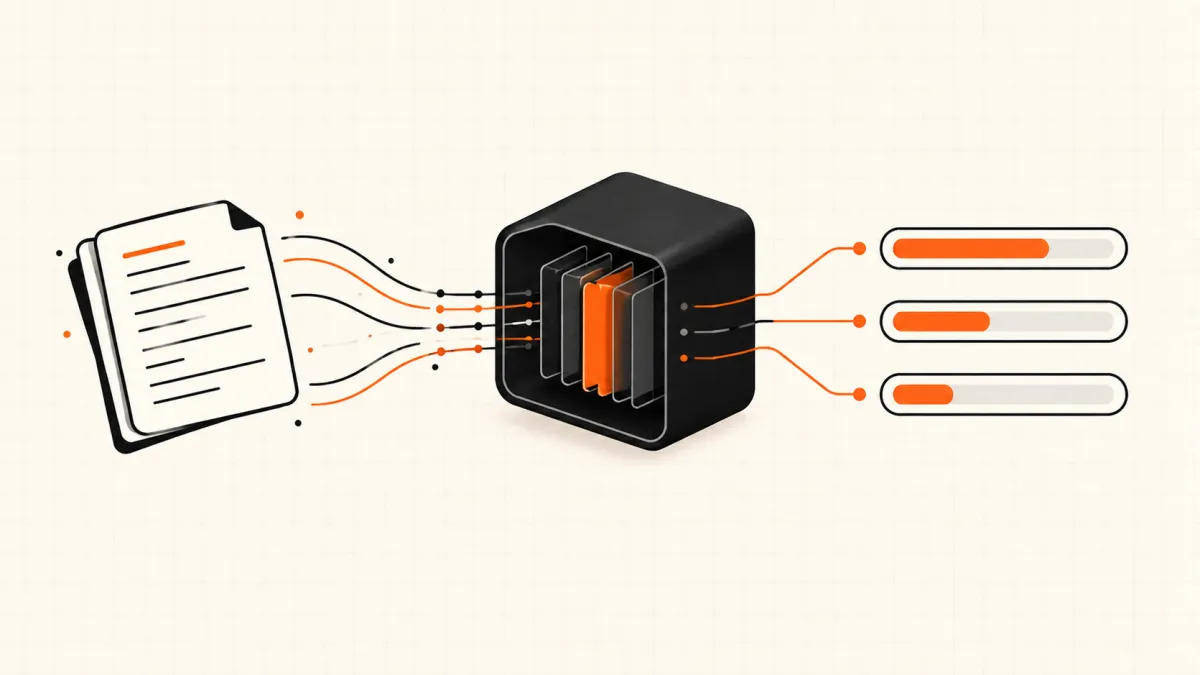

Most engineering teams start building classifiers the same way: prompt a general LLM with "Classify this text into one of 5 categories and return JSON." It works in staging, then falls apart in production—latency spikes past 3 seconds, JSON parsing breaks on edge cases, and the token bill scales linearly with traffic. Switching to Jev AI classification eliminates all three bottlenecks by using a purpose-built decision model that returns calibrated probabilities in ~300 ms.
This blueprint shows how to design a reliable Jev AI classification pipeline for moderation, LLM routing, and ticket triage, how to tune probability thresholds, and how to test your taxonomy immediately on jev-ai.org. All latency and cost numbers below reference verified benchmarks from TypeSafe AI, Vercel's TechCrunch report, and our own measurements on jev-ai.org.
TL;DR
- Why Jev AI classification beats LLM prompting: ~310 ms median round-trip latency and ~$0.00003 per call in our tests, with native calibrated probabilities and zero malformed JSON prose.
- Proven in production: A Vercel engineer reported 5–18× faster execution and higher accuracy on a live safety classifier compared to an LLM.
- Key architectural pattern: Use Jev AI classification with a three-zone threshold (
auto-accept,escalate to LLM/human,auto-reject) rather than a blind 0.50 cutoff. - Test in 60 seconds: Prototype your labels live on the Jev AI Model Playground.
Why Standard LLM Classifiers Break Under Load
| Pain Point | General LLM Prompt | Jev AI Classification |
|---|---|---|
| Latency | 2–10+ seconds (blocks UX) | ~114–400 ms (middleware-safe) |
| Output reliability | Occasional markdown wrappers or hallucinated labels | Strictly typed choice probabilities |
| Confidence calibration | Self-reported scores are notoriously overconfident | Native calibrated probability scores |
| Multi-label checks | Requires long prompts or multiple calls | Parallel boolean questions in one pass |
Designing a Production Jev AI Classification Pipeline
Follow four concrete rules to get high precision from Jev AI classification:
1. Write Mutually Exclusive, Behavior-Based Labels
Vague categories ("other", "general", "misc") hurt every classifier. Define each Jev AI classification label with a short operational test—for example, "billing_refund: user explicitly asks for a refund, invoice correction, or duplicate charge reversal".
2. Use Three-Zone Probability Thresholds
Never treat a 0.52 score the same as a 0.97 score. Because Jev AI classification returns calibrated probabilities:
p >= 0.85: Execute the automated action immediately (route, block, or tag).0.35 <= p < 0.85: Escalate to a heavier LLM or human review queue.p < 0.35: Pass through as negative.
In practice, 80–90% of traffic resolves automatically in ~300 ms while only the genuinely ambiguous 10–20% pays frontier LLM latency.
3. Combine Safety + Intent in One Parallel Call
Instead of running a moderation classifier and then an intent router sequentially, pack both into a single Jev AI classification request:
is_prompt_injection(boolean)violates_safety_policy(boolean)route_tier(simple_faq|code_generation|complex_reasoning)
One round trip gives you guardrails and smart model routing at the same time.
4. Benchmark on 300 Real Labeled Examples
As independent developer pilots showed in our Jev Benchmarks roundup (achieving 0.910 and 0.870 accuracy on two zero-shot datasets, and 0.480 on a harder third dataset), zero-shot accuracy varies by domain. Always evaluate Jev AI classification on 200–300 real labeled rows from your own product before shipping.
Three High-ROI Jev AI Classification Patterns
- Pre-LLM Guardrails: Block prompt injections and off-topic abuse in ~300 ms before touching an expensive chat model.
- Smart Model Routing: Route easy queries to cheap fast models and hard queries to flagship models using Jev AI classification—often cutting total LLM spend by 40–60%.
- E-Commerce & SaaS Support Triage: Auto-tag urgent churn risks, refund requests, and bug reports the instant a message arrives.
Prototype Your Classifier Now
Open the Jev AI Model Playground to test your labels interactively, or wire Jev AI classification directly into Python/JS with our LangChain TypeSafeClassifier guide and Vercel AI Gateway guide.
Frequently Asked Questions
How accurate is Jev AI classification compared to a frontier LLM?
On well-defined safety and routing taxonomies, Jev AI classification matches or beats general LLMs at a fraction of the latency (Vercel reported 5–18× faster execution with higher accuracy on a safety classifier). On nuanced edge cases, pairing Jev with an uncertainty fallback to an LLM gives the best of both worlds.
Can Jev AI classification run multi-label checks in one request?
Yes. You can evaluate multiple parallel boolean and categorical questions against the same input in a single Jev AI classification call.
How fast is Jev AI classification for real-time middleware?
Our production-shaped calls on jev-ai.org measured a median round-trip time of ~310 ms, fast enough to sit directly in API gateways and chat pre-filters.
Where can I test Jev AI classification before writing code?
Test your own text samples and label definitions immediately on the Jev AI Model Playground.
Sources
- jev-ai.org Playground — Live browser workspace for testing Jev AI classification (checked November 27, 2026).
- TypeSafe AI Jev Benchmarks (jev-ai.org) — Source for Vercel safety classifier results, independent zero-shot accuracy pilots, and latency measurements.
- LangChain Jev Guide (jev-ai.org) — Integrating
TypeSafeClassifierin Python and JavaScript. - Vercel AI Gateway — Edge gateway routing documentation.